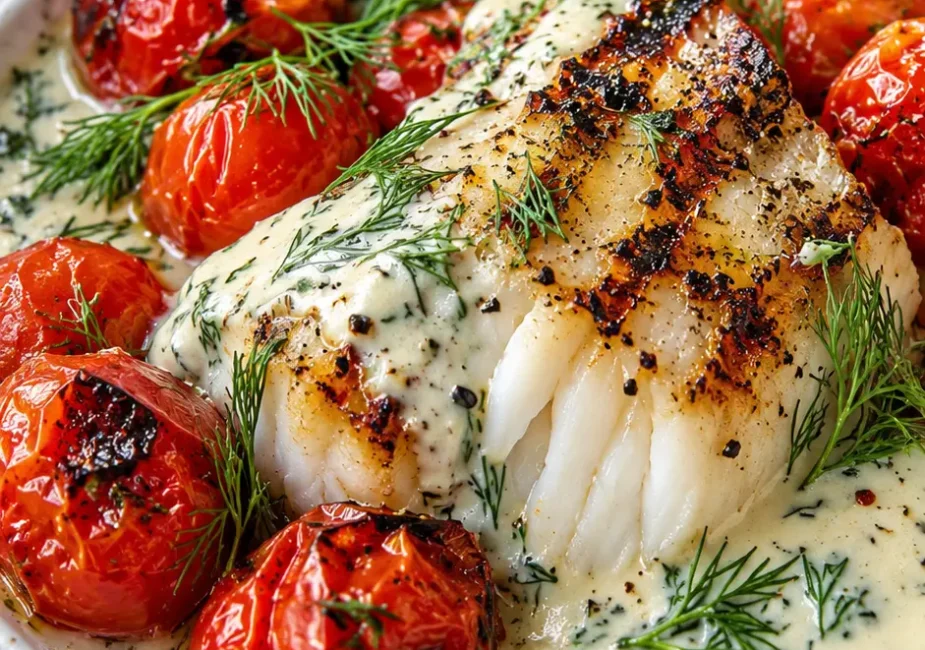
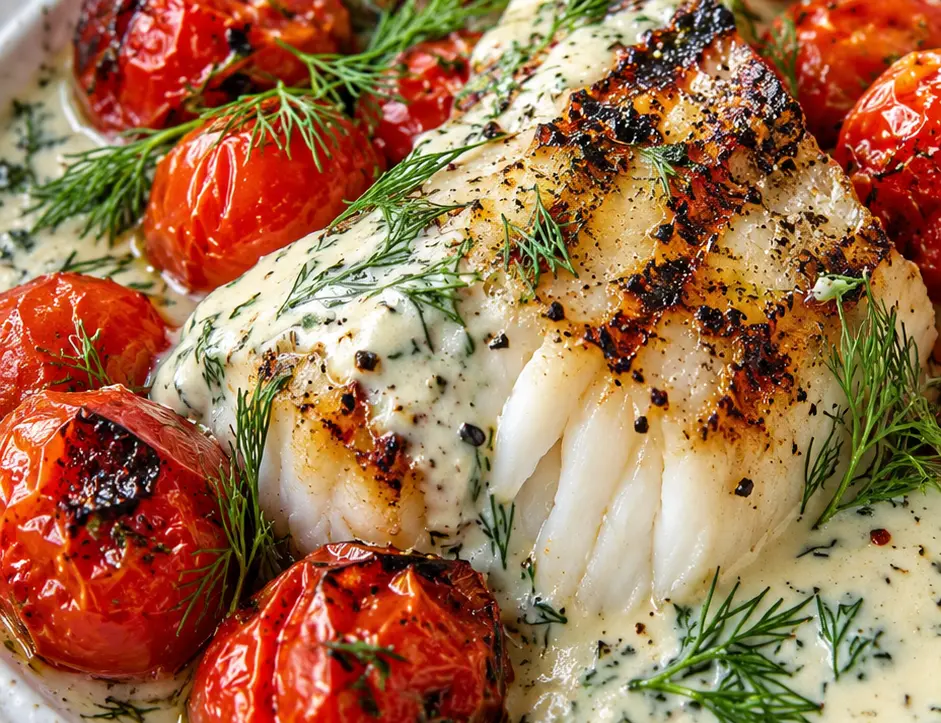
White fish off a grill has a signature sound that quiet hiss, then the moment your fork goes in and the flakes lift like pages. Charred at the edges, sweet and mild at the center, with a cool, herby dill sauce pooling alongside and lemon-scented smoke still drifting over the plate. That’s this dinner.
Quick grilled cod with creamy dill sauce is about 25 minutes from deciding to cook to sitting down, and it leans on one habit too many recipes skip: salt the cod before you light anything. The grill takes a few minutes to come around; the salt doesn’t care. Here’s how it all lands on the plate.
Why This Recipe Works
- Salt first, grill second. Cod salted 15–20 minutes before it hits the grate seasons through the whole fillet, firms the flesh so it holds together over the bars, and pulls the surface moisture that otherwise turns fish into steamed, bland disappointment. This is the engine of the whole recipe.
- A sauce that covers two jobs. The creamy dill sauce does brightness and richness at once cool, tangy, herb-forward so the fish needs no butter brushing and no marinade babysitting.
- Under ten minutes of actual heat. Six to nine minutes depending on thickness. That’s the fastest “special-occasion” dinner this site has ever published.
- Scales without flinching. Two fillets or eight? Same temperature, same timing, same salt-first rule.
- Several diet boxes checked at once. Keto, low-carb, and gluten-free as written, with no substitutions and no apologies.
Recipe At a Glance
- Prep time: 10 minutes (plus 15 minutes of passive salting time)
- Cook time: 6–10 minutes
- Total time: ~25–30 minutes
- Servings: 4
- Estimated nutrition per serving (of 4): 260 calories | 34 g protein | 12 g fat | 4 g carbs estimates, not medical advice.
Ingredients
For the creamy dill sauce:
- ½ cup plain full-fat Greek yogurt
- 2 tbsp mayonnaise
- 2 tbsp fresh dill, finely chopped
- 1 tbsp fresh lemon juice
- 1 small garlic clove, finely grated
- ¼ tsp kosher salt
- Fresh black pepper, to taste
For the cod:
- 4 cod fillets (about 6 oz / 170 g each), skinless and about 1 inch thick
- 1 tsp kosher salt, for the early salting
- 1 tbsp olive or avocado oil
- Cracked black pepper
- Lemon wedges and extra dill, for serving
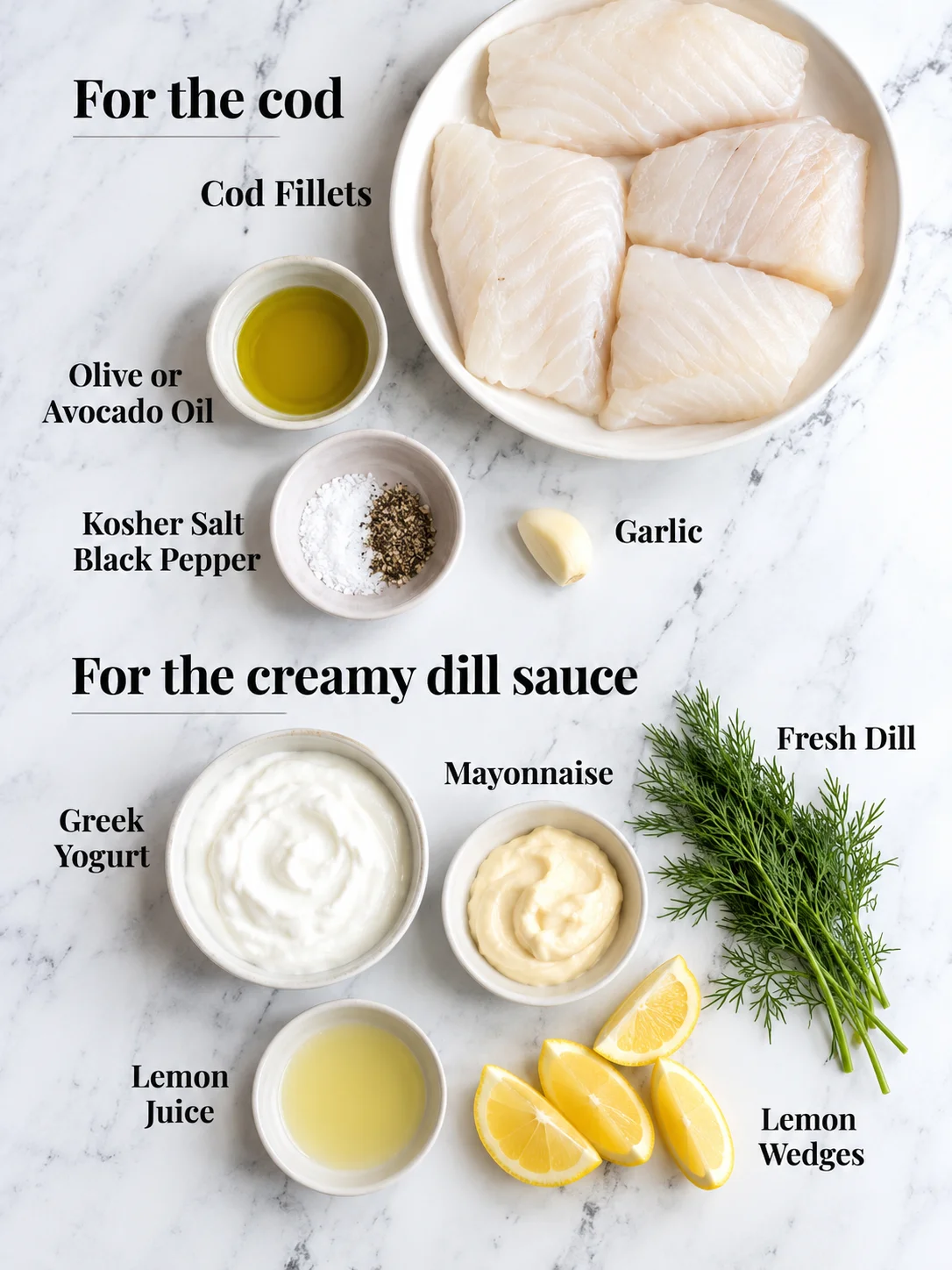
Notes: Fresh dill is the one ingredient I won’t negotiate. Dried dill is a sad, dusty echo of it if that’s all you have, you need 2 tsp, and still expect less. And if your cod comes thinner than an inch, shave a minute off each side and check early; thin white fish travels from done to dry between two breaths.
Equipment Needed
- Outdoor grill or a cast-iron grill pan
- Paper towels
- Small bowl for the sauce
- Fine grater (Microplane is ideal)
- Fish spatula
- Instant-read thermometer it’s a few dollars and it ends every “is it done yet?” argument.
How to Make Quick Grilled Cod with Creamy Dill Sauce
Salt the cod immediately. Sprinkle the kosher salt evenly over both sides of each fillet the moment you commit to making this at least 15 minutes before the grill comes on. Here’s the reasoning that matters: salt first pulls moisture to the surface, then reverses course and moves back in, carrying seasoning deep while firming the proteins. The payoff is cod that’s seasoned all the way through and steady enough to survive one decisive flip. Salt it at the grill and you only season the outer millimeter while the surface water steams. And don’t push the salting past an hour the exterior starts to set and turns dense.
Make the sauce and let it sit. Whisk the yogurt, mayonnaise, dill, lemon juice, garlic, salt, and a few cracks of pepper in a small bowl. Taste it it should be bright enough to make you wince pleasantly. Set it aside for at least 10 minutes; the garlic sharpens and the dill settles in. Pro tip: leave the sauce out of the fridge for those 10 minutes, because arctic-cold sauce dumped on hot fish reads lukewarm in the middle. Nobody wants that.
Dry and oil the fish. Before grilling, blot the salted fillets dry with paper towels the salt has done its job, and any sitting moisture is now just steaming fuel. Brush both sides lightly with oil and add cracked pepper. No pepper on the salt-early step; salt and pepper each get their own moment.
Heat the grill to medium-high. About 450°F (230°C). Oil the grates with a paper towel held in tongs, because oiled grates plus oiled fish is the combination that lets white fish release instead of tearing.
Grill, flip once, resist the urge to fiddle. Lay the fillets on and leave them alone for 4–5 minutes. Don’t pry. When the fish is ready, a spatula slides beneath it with zero resistance if it sticks, give it 30 more seconds and try again. Flip once and cook 2–4 minutes more, until the thickest part of the biggest fillet reads 140–142°F and the flesh is opaque, flaking when you nudge it. (Carryover heat carries it the rest of the way to 145°F.) The topside should be pale gold at the edges with a faint toasted-sweet smell.
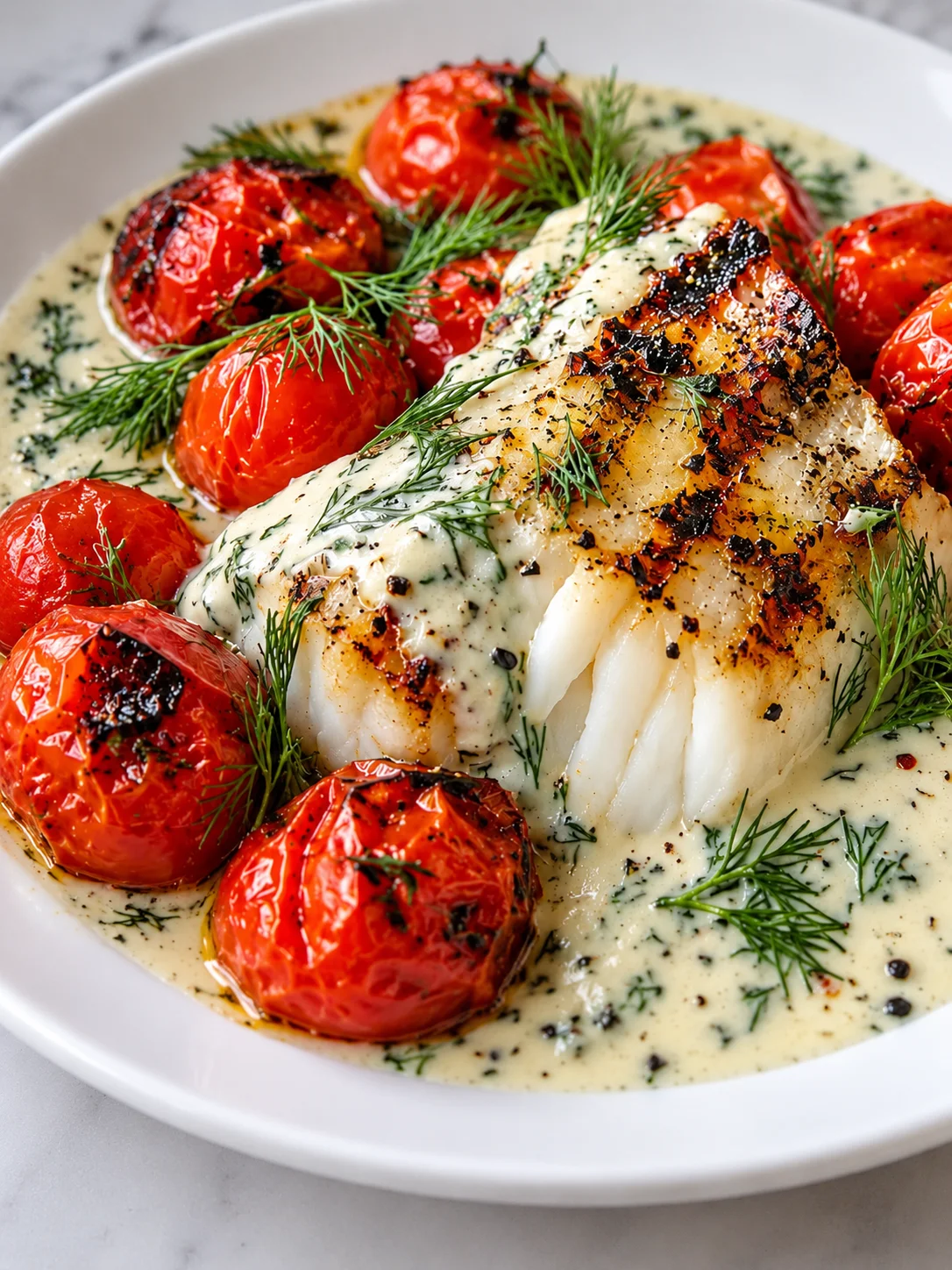
Rest, then sauced. Let it rest 3 minutes, then finish. A short, uncovered rest lets the flakes settle so they hold together on the way to the plate. Spoon the dill sauce generously alongside (or over, for cod it doesn’t fight the sauce), tuck in lemon wedges, scatter a little extra dill, and get it to the table before the smoke stories start.
Common Mistakes to Avoid
- Salting at the last second. Seasoning right before the grill gives you a salty shell over a bland, watery middle. The 15-minute head start is what carries flavor deep and firms the flesh cut the corner here and the whole trick collapses.
- Flipping early. Prying a fish that isn’t ready shreds it into nuggets. If the spatula meets resistance, wait. One flip, full stop.
- Cooking until it looks “well done.” White fish turns chalky and cottony the moment it passes about 150°F. Pull at 140–142°F and let resting do the last few degrees.
- Chilling the sauce until serving. Fridge-cold sauce on hot fish is a sadness sandwich. Give it 10 minutes at room temperature before you plate.
- Wrong grill temperature. Too hot burns the outside before the center cooks; too cool and it sticks and steams. Medium-high, oiled fish, oiled grates that’s the whole arithmetic.
How to Store & Reheat
Cooked cod keeps in the fridge for up to 2 days in an airtight container. Reheat gently 300°F oven for about 6–8 minutes, or a covered skillet over medium-low with a splash of water for a few minutes. Microwaving works in 20-second bursts if you must, but white fish punishes enthusiasm. The sauce keeps separately for 2–3 days; stir it once before serving. Freezing: raw cod freezes beautifully for 2–3 months sealed well, but cooked cod freezes so-so the flakes turn mealy on thaw. This one is a cook-it-that-night recipe, and at 25 minutes, that’s never an inconvenience.
Recipe Variations & Substitutions
- Other white fish: halibut, haddock, or even tilapia all obey the same salting rule. Adjust minutes by thickness, not by type.
- Sauce swaps: sour cream for the yogurt, chives for half the dill, or a small spoonful of grainy mustard if you like a little bite.
- Dairy-free: a thick coconut yogurt works well, or go simpler mayo whisked with lemon and dill alone makes a shockingly good thin dressing.
- Spice it: a pinch of cayenne in the sauce, or smoked paprika dusted over the fish before grilling for a gentle, dark char.
- Indoor version: a cast-iron grill pan at medium-high, same flips, same temperature pull.
- Lemon-forward: grill lemon halves cut-side down for 2 minutes to caramelize, then squeeze those over the fish. It’s a small move with an outsized effect.
- Broiler route: 425°F broiler, rack about 6 inches down, 6–8 minutes total without flipping.
Nutritional/Health Angle
Honest numbers first: at about 260 calories and 34 grams of protein per serving, this dinner does most of its work with cod’s lean protein, which is about as uncomplicated a protein source as exists. The fat comes from the yogurt, the mayo, and a small brush of oil nothing excessive, all flavor-bearing. It’s naturally low-carb, keto-friendly, and gluten-free as written, with no added sugar anywhere in the lineup. None of this is a health claim; it’s just an unusually clean dinner that happens to go down like a treat.
FAQ
What if I don’t have a grill?
A cast-iron grill pan at medium-high reproduces the same marks and timings indoors, or use a regular heavy skillet if that’s what you own. The broiler is the third option 425°F, rack about 6 inches from the heat, 6–8 minutes without flipping. Every route obeys the same rule: salt early, pull at 140–142°F, rest.
How do I know when the cod is cooked?
The thermometer wins: pull at 140–142°F at the thickest point and resting finishes the job. Without one, look for flesh that’s opaque all the way through and flakes cleanly under a fork not before. If it’s still translucent at the center, it’s not done; if it’s starting to crack into dry shards, you’ve gone too far.
Can I use frozen cod?
Yes — thaw overnight in the fridge (or in a covered bowl of cold water for an hour or two), and pat it very dry before salting. Frozen fish gives off more moisture than fresh, which makes the early salting even more worthwhile. Just stick to the 15-minute-to-an-hour window.
Can I make the sauce ahead of time?
Up to two days, in a sealed container in the fridge. Stir it once or twice before serving, and remember the room-temperature rule — pull it out a solid 10 minutes before the fish lands. The dill keeps its personality and the garlic sharpens, which is a feature.
Is this keto and gluten-free?
Yes, exactly as written. Greek yogurt and mayonnaise are both fine on keto, nothing here contains gluten, and there’s no added sugar in the recipe. If you’re dairy-free, the coconut-yogurt swap above keeps both claims intact.
What should I serve with it?
Roasted potatoes and dill are a classic pairing the same herb works both plates. Otherwise: steamed rice, grilled asparagus, or a sturdy green salad. The sauce is also quietly excellent as a dip for firm grilled vegetables, so budget generously when you make it.
Final Thoughts
So the whole bundle of good luck here reduces to one deliberate choice: salt the cod early, and treat the grill like a formality. The sauce does its job, the hot grates do theirs, and you end up with dinner that looks like someone else made it in roughly one episode of a podcast. It’s the kind of recipe that makes fish feel easy, which is the entire win. The sauce is the playground, too: sour cream for yogurt, a spoon of capers, a heavy hand on the dill. Which way do you take yours? Tell me in the comments I’m always hunting for a new sauce habit.
For the creamy dill sauce:
- ½ cup plain full-fat Greek yogurt
- 2 tbsp mayonnaise
- 2 tbsp fresh dill finely chopped
- 1 tbsp fresh lemon juice
- 1 small garlic clove finely grated
- ¼ tsp kosher salt
- Fresh black pepper to taste
For the cod:
- 4 cod fillets about 6 oz / 170 g each, skinless and about 1 inch thick
- 1 tsp kosher salt for the early salting
- 1 tbsp olive or avocado oil
- Cracked black pepper
- Lemon wedges and extra dill for serving
Outdoor grill or a cast-iron grill pan
Paper towels
Small bowl for the sauce
Fine grater (Microplane is ideal)
Fish spatula
Instant-read thermometer it’s a few dollars and it ends every “is it done yet?” argument.
Salt the cod immediately. Sprinkle the kosher salt evenly over both sides of each fillet the moment you commit to making this at least 15 minutes before the grill comes on. Here’s the reasoning that matters: salt first pulls moisture to the surface, then reverses course and moves back in, carrying seasoning deep while firming the proteins. The payoff is cod that’s seasoned all the way through and steady enough to survive one decisive flip. Salt it at the grill and you only season the outer millimeter while the surface water steams. And don’t push the salting past an hour the exterior starts to set and turns dense.
Make the sauce and let it sit. Whisk the yogurt, mayonnaise, dill, lemon juice, garlic, salt, and a few cracks of pepper in a small bowl. Taste it it should be bright enough to make you wince pleasantly. Set it aside for at least 10 minutes; the garlic sharpens and the dill settles in. Pro tip: leave the sauce out of the fridge for those 10 minutes, because arctic-cold sauce dumped on hot fish reads lukewarm in the middle. Nobody wants that.
Dry and oil the fish. Before grilling, blot the salted fillets dry with paper towels the salt has done its job, and any sitting moisture is now just steaming fuel. Brush both sides lightly with oil and add cracked pepper. No pepper on the salt-early step; salt and pepper each get their own moment.
Heat the grill to medium-high. About 450°F (230°C). Oil the grates with a paper towel held in tongs, because oiled grates plus oiled fish is the combination that lets white fish release instead of tearing.
Grill, flip once, resist the urge to fiddle. Lay the fillets on and leave them alone for 4–5 minutes. Don’t pry. When the fish is ready, a spatula slides beneath it with zero resistance if it sticks, give it 30 more seconds and try again. Flip once and cook 2–4 minutes more, until the thickest part of the biggest fillet reads 140–142°F and the flesh is opaque, flaking when you nudge it. (Carryover heat carries it the rest of the way to 145°F.) The topside should be pale gold at the edges with a faint toasted-sweet smell.
Rest, then sauced. Let it rest 3 minutes, then finish. A short, uncovered rest lets the flakes settle so they hold together on the way to the plate. Spoon the dill sauce generously alongside (or over, for cod it doesn’t fight the sauce), tuck in lemon wedges, scatter a little extra dill, and get it to the table before the smoke stories start.
Quick Grilled Cod with Creamy Dill Sauce
Last modified: September 24, 2026