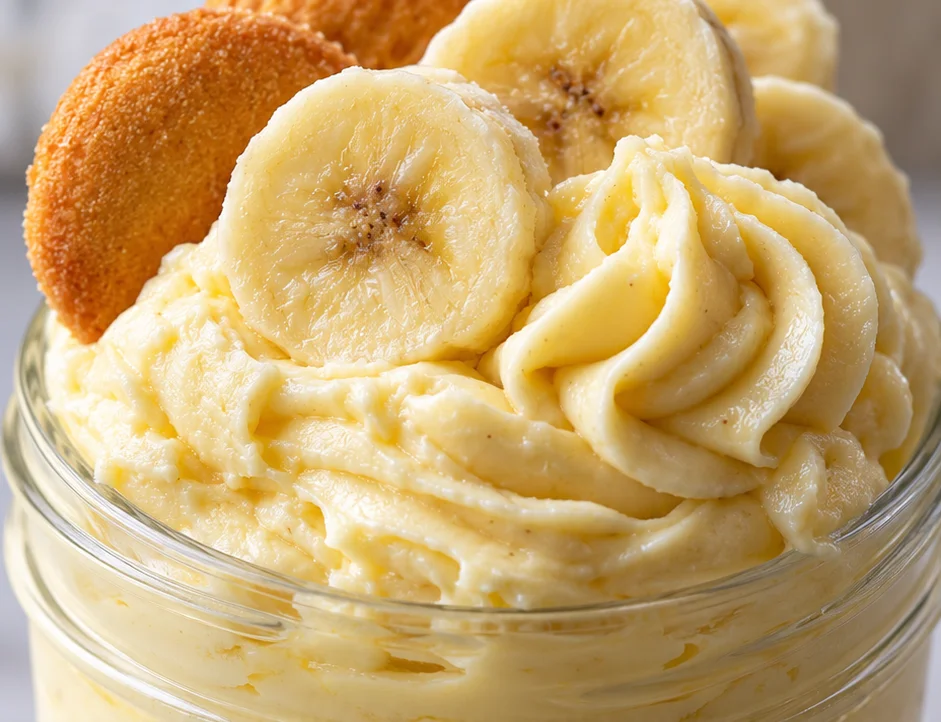
Whisk the banana pudding mix into the 1/2 cup of cold water with the vanilla. It’ll look thin and slightly gluey, which is correct. Leave it on the counter for 10 minutes, then stir once. This is instant pudding, so those ten minutes aren’t optional and they’re not about safety. The powder thickens through the same starch-gelatinizing process a cooked pudding goes through, just faster. If you skip the wait and pour the base into the butter while it’s still liquid, you’ll have a thinner frosting that starts pooling in the center of the cake within the hour.
This is the step that decides how the frosting turns out, and it’s the one people get wrong by an amount that feels too small to notice. You want the butter at 65 to 68°F. Cold, it won’t cream. Warm, it goes greasy. But “room temperature” on most kitchen counters is 70°F and climbing, and there’s a real difference between 68 and 72. Here’s what those few degrees cost you. Butter is a structure of small crystals suspended in oil. Beat it while it’s cool and those crystals give you something solid to build air into, and you get a frosting that comes up light and matte and holds a soft ridge where you drag the spatula. Push past about 70°F and the crystals melt into the oil phase, the thing you were building air into has nothing to anchor to, and suddenly you have a frosting that looks fine right up until it looks faintly oily and starts sliding down the side of the cake. Practical version: cut the stick into cubes, leave them out 10 to 15 minutes, then press one. It should dent easily under your thumb and still feel slightly cool to the touch. Not giving a dent? Back in the fridge for 10 more minutes. Denting and feeling genuinely warm? Ice bath, five minutes. I made this frosting twice on the same cake, one batch off butter at 68 and one at 73, and handed them to two people without saying anything about the difference. Both picked the cooler one.
Beat the butter on medium-high for 2 to 3 minutes, scraping the bowl down twice, until it looks noticeably lighter in color and fluffy with a soft, dull surface rather than shiny. Scrape the bowl every 60 seconds or so. Frosting climbs the sides while you beat, and that butter sitting against the bowl wall is not getting aerated. Stop here. This is the other half of the temperature story butter breaks down into grains and then goes oily somewhere around the five-minute mark, and once it does there’s no coming back. Pale and fluffy is the finish line, not glossy and fast.
With the mixer on low, add about 1 1/2 cups of the sifted powdered sugar plus the salt. Let it come together, then add the rest.Low speed here, not medium. The powdered sugar will cloud up the bowl and you don’t want it aerosolizing all over your kitchen, and low speed gives the sugar time to hydrate instead of just flying around on top of the butter.
Beat on medium-high, adding the thickened banana pudding base a tablespoon at a time, until everything is smooth and glossy. Scrape once more. Now here’s the adjustment, and it’s the only other thing you’re really tuning: the frosting should be soft and spreadable. If it looks stiff and crumbly, add a tablespoon of milk. If it’s loosening and starting to drip off the spatula, add a tablespoon more powdered sugar. Stop while it still holds a peak. Frosting that looks a fraction too loose in the bowl spreads like a coating; frosting that’s a fraction too firm thins out as it hits a warm cake. Aim for the middle.
Pop the bowl in the fridge for 10 to 15 minutes. Cool butter plus a short chill gives you a frosting that holds its shape on the cake instead of relaxing into it. On the cake itself: let the layers cool in their pans for 20 minutes, then turn them out onto a rack and cool all the way to room temperature. Not just the top. The inside of a warm cake is warm for a long time and it’ll cut straight through the frosting and take crumb with it. Then spread, and don’t worry about making it perfect. This frosting smooths out beautifully with an offset spatula once it’s set.